Quick answer. No. Reflective film is an optical product: it returns light from a headlight or torch back toward the viewer. Photoluminescent film is a chemical one: it absorbs light while the area is lit and re-emits it slowly after the light goes out. One is invisible without an external light source; the other is invisible until the external light source disappears. They are specified against different standards, measured with different instruments, and bought for different reasons. The only things they share are the word "film" and the fact that both end up on safety signage.
| Question |
Short answer |
| Is photoluminescent film the same as reflective film? |
No. Reflective film returns light to its source; photoluminescent film absorbs light and re-emits it in darkness. |
| Does reflective film glow in the dark? |
No. It is visible only while a light source such as headlights or a torch is pointed at it. |
| Does photoluminescent film show up in headlights? |
Only weakly. It has no retroreflective optics unless the construction is a hybrid. |
| Which one belongs on a road traffic sign? |
Reflective sheeting specified to GB/T 18833-2012, ASTM D4956 or EN 12899-1. |
| Which one belongs on an escape route? |
Photoluminescent film specified to ISO 17398, DIN 67510 or ASTM E2072. |
| Can one product do both? |
Yes, hybrid photoluminescent-reflective film exists, but both properties must be tested and reported separately. |
Two Different Visibility Problems
A road sign answers one question: can a driver read it while the headlights are on it? An escape route marking answers a different one: can a person find the stair when every light in the building is off? The first is a retroreflection problem. The second is a stored-light problem. Neither material solves the other's problem, and a project that needs both is a project that needs two products, or one hybrid product with two sets of test data.
The photoluminescent film vs reflective film distinction matters most at the buying stage, because the two products look similar in a catalogue photograph and are often sold under loose names such as "glow in the dark film". A buyer who orders on that phrase can receive either material and have no document to prove which one arrived.
How Each Film Produces Light
Reflective film works by retroreflection. Light from a headlight hits the sheeting and is returned in a narrow cone back toward the source. Two constructions dominate: enclosed glass beads, where light is refracted through a bead and reflected by a coated hemisphere, and microprisms, where light is reflected by three mutually perpendicular faces. Retroreflection is measured as the coefficient of retroreflection, RA, in cd·lx⁻¹·m⁻², at a stated observation angle and entrance angle. Change either angle and the number changes, which is why a quoted RA value without geometry is not a specification.
Photoluminescent film works by phosphorescence. A phosphor in the film absorbs photons, traps part of that energy, and releases it over time as visible light. Alkaline earth aluminates activated with rare earths are the common family; the emission is typically in the green part of the spectrum, around 520 nm, where the dark-adapted eye is most sensitive. Three consequences follow. The film must be excited before it can glow. Brightness decays quickly in the first minutes and then slowly for hours. And the emission colour depends on the phosphor, not on the colour of the film in daylight — a red-looking film may glow orange, a white one may glow blue.
| Mechanism |
Reflective film |
Photoluminescent film |
| What it does with light |
Returns it toward the source |
Absorbs it, stores it, re-emits it |
| Works with no light source |
No |
Yes, until the stored energy is spent |
| Measured as |
RA at a stated angle pair |
Luminance over time after excitation |
| Fails when |
Surface is dirty, wet or damaged |
Excitation is weak or the phosphor degrades |
| Typical document |
Retroreflection test report |
Luminance decay report |
Hybrid products combine a retroreflective base with a phosphorescent layer. They are legitimate and useful — tunnel lower walls and marine escape routes are two examples — but they must be bought with two reports, one for RA and one for luminance decay. A hybrid that passes only one of the two tests is a single-function product with a two-function price.
The Standards Are Not Interchangeable
Standards are where the two categories separate cleanly, and where procurement can protect itself with one question: which clause of which standard does this report test?
| Application |
Standard |
What it actually controls |
| Road traffic signs, China |
GB/T 18833-2012 |
Reflective sheeting classes I–V, RA and chromaticity |
| Road traffic signs, international |
ASTM D4956 / EN 12899-1 |
Retroreflective sheeting types and RA classes |
| Vehicle markings |
ECE 104 / DOT C2 |
Conspicuity tape performance |
| Safety signs, general |
ISO 17398 |
Classification, performance and durability of safety signs |
| Photoluminescent products |
DIN 67510 |
Measurement and classification of pigments and products |
| Photoluminescent safety markings |
ASTM E2072 / E2073 |
Product specification and photopic luminance test |
| Emergency exit signage |
UL 924 |
Emergency lighting and exit sign performance |
| Marine escape routes |
IMO / MED requirements |
Low-location escape route marking systems |
Lianxing publishes its reflective sheeting against GB/T 18833-2012: the 3H 2000 series is declared as Class II material and the 3H 4000 series as Class IV. That is a statement a buyer can verify clause by clause. The Lianxing photoluminescent sheets are published by rated glow duration and luminance values, not by a DIN or ISO class, so a specifier working to a class-based specification must request the class evidence separately.
A D4956 report cannot validate a photoluminescent product, and a DIN 67510 report cannot validate retroreflection. Photoluminescent safety signs are normally specified by class, and that class has to come from a DIN 67510 or ISO 17398 test report, not from a duration claim on a brochure. Any supplier who offers one document for both properties is describing a hybrid without testing it as one.
Parameters That Predict Field Performance
Reflective film: one number, one geometry
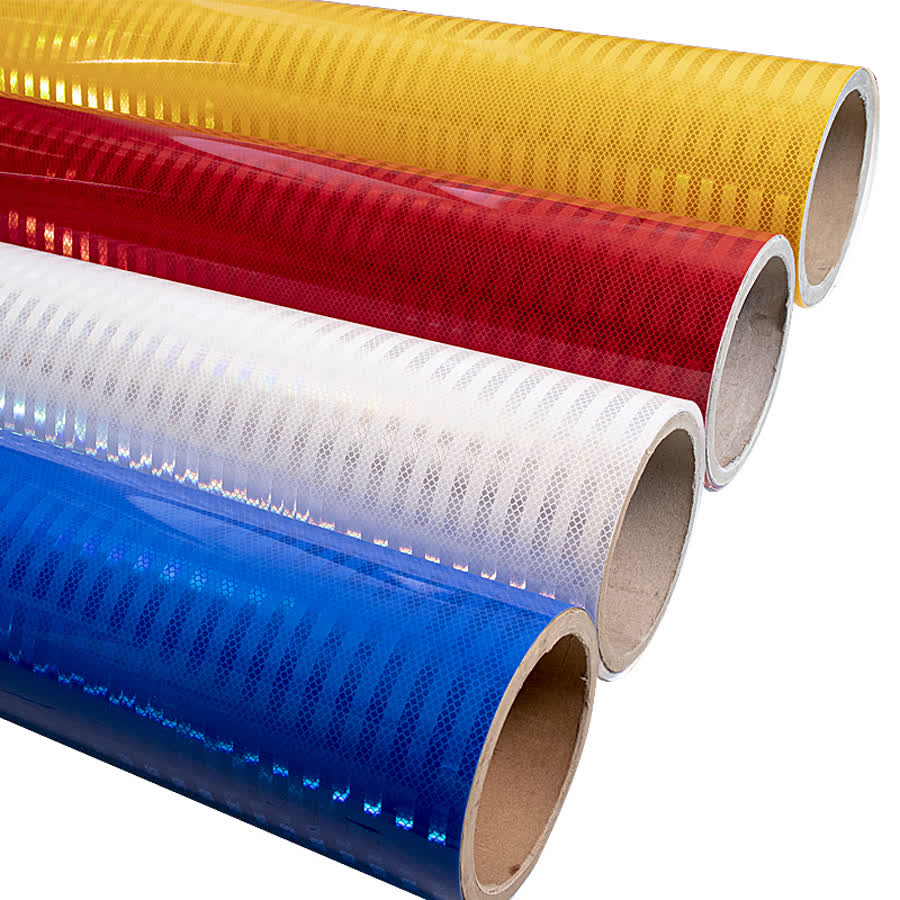
Lianxing publishes front-side RA values for reflective sheeting for traffic signs in both series, together with the value retained within the service life. The table below is quoted from those datasheets, for white through brown.
| Colour |
3H 2000 (Class II) |
Retained within service life |
3H 4000 (Class IV) |
Retained within service life |
| White |
250 |
200 |
360 |
288 |
| Yellow |
170 |
136 |
270 |
216 |
| Orange |
100 |
80 |
145 |
116 |
| Red |
50 |
40 |
65 |
52 |
| Green |
45 |
36 |
50 |
40 |
| Blue |
20 |
16 |
30 |
24 |
| Brown |
12 |
9.6 |
18 |
14.4 |
Values in cd·lx⁻¹·m⁻², front side, per GB/T 18833-2012. Both series are 0.46 mm total thickness (0.38 mm film, 0.08 mm liner), supplied in 1.22 m × 45.72 m rolls, rated for −20 °C to 60 °C and a ten-year outdoor service life.
Two reading rules apply. First, compare values at the same observation and entrance angle; a white 360 measured at one geometry is not comparable with a competitor's 360 measured at another. Second, the retained value matters more than the new value: a sign is bought once and inspected for a decade, and the number that decides whether it still complies in year eight is the second column, not the first.
Photoluminescent film: a curve, not a number
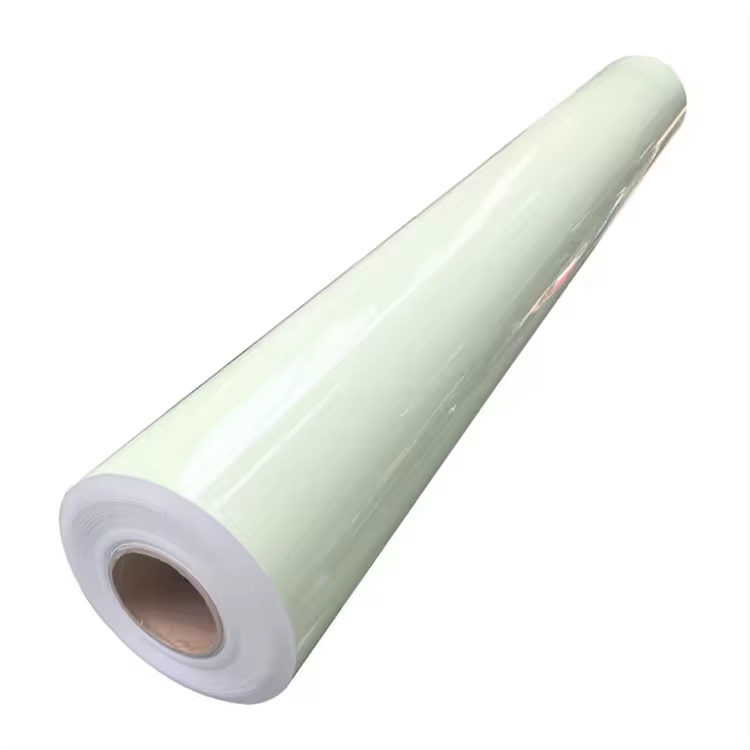
Lianxing's PVC sheets run from a two-hour to a ten-hour rated glow, and the PET sheets from two to six hours. Initial luminance ranges from 1,802 to 12,090 mcd/m² across the PVC range and from 2,066 to 5,941 mcd/m² across the PET range.
| Model |
Substrate |
Rated glow |
Initial luminance (mcd/m²) |
Luminance at end of rated glow (mcd/m²) |
| YG-202 |
PVC |
2 h |
1,802 |
3 |
| YG-203 |
PVC |
4 h |
2,346 |
2.3 |
| YG-206 |
PVC |
6 h |
5,414 |
2.27 |
| YG-208 |
PVC |
8 h |
8,744 |
2.5 |
| YG-210 |
PVC |
10 h |
12,090 |
4 |
| YG-102 |
PET |
2 h |
2,066 |
3 |
| YG-103 |
PET |
4 h |
2,500 |
2.3 |
| YG-106 |
PET |
6 h |
5,941 |
4.84 |
The number that decides an egress application is not the headline duration. It is the luminance after the first ten minutes, because that is when people are still on the stairs. Across the Lianxing range those ten-minute values run from 62 to 266 mcd/m², and the difference between the low and high end is the difference between a marking that reads clearly in a blackout and one that merely exists. Ask for the ten-minute value, the excitation illuminance and the excitation duration together; a decay curve without its charging conditions cannot be reproduced.
PVC or PET: a processing decision, not a brightness one
Both substrates share the same 0.32 mm minimum thickness, 380 g/m² minimum weight and 1.24 m × 45.7 m roll, and both are rated for a six-month shelf life.
| Property |
PVC photoluminescent film |
PET photoluminescent film |
| Rated glow |
2–10 h |
2–6 h |
| Initial luminance |
1,802–12,090 mcd/m² |
2,066–5,941 mcd/m² |
| Printing |
Inkjet, screen print, cutting, lettering |
Screen print, cutting, lettering |
| Surface |
Gloss |
Wear resistant, easy lettering |
| Best fit |
Printed safety graphics, colour work |
Cut lettering, high-traffic touch surfaces |
The selection rule is short. If the sign carries a printed pictogram or a colour image, PVC is the substrate. If the sign is cut lettering that will be handled, cleaned and abraded, PET is the substrate. Neither choice changes the fact that the material only glows after it has been charged.
Five questions that expose a weak datasheet
- What is the RA at a stated observation and entrance angle, and what is the retained value?
- What is the photoluminescent luminance at ten minutes, and at what excitation illuminance and duration was it measured?
- Which standard class does the product hold, and which laboratory report proves it?
- What is the adhesion value, on which substrate, by which test method?
- What is the shelf life, and how is it affected by storage temperature and humidity?
A datasheet that answers fewer than four of these is a brochure, not a specification.
Where Each Film Belongs: Six Scenarios
Rural and secondary roads. Signs are read on headlights alone, at distance and often at an angle. Retroreflection dominates, and the retained RA value decides how long the sign keeps working after surface dirt and UV exposure have taken their share.
Urban overhead gantries. The entrance angle is large because the sign is above the driver's eye line. Wide-angle performance matters more than peak front-side RA, and this is exactly the number that must be requested explicitly.
Building egress stairs and corridors. There is no headlight and no power. Photoluminescent film is the only passive option, and the ten-minute luminance plus the marking layout decide whether the route is followable.
Underground car parks. Columns, kerbs and exit path markings need low-level visibility after a lighting failure, while vehicle circulation still needs reflective delineation. The two requirements usually sit on different surfaces in the same structure.
Marine and offshore. Life-saving appliances and escape routes follow IMO and MED requirements; retroreflective tape and photoluminescent low-location marking are separate line items in the same specification, not alternatives.
Tunnels and enclosed roads. Lower walls and escape route markings combine both functions. A hybrid product is appropriate here, provided the RA report and the luminance decay report are both supplied and both tested after the hybrid construction, not before it.
Selection Matrix
| Application |
Light condition |
Dominant risk |
Material |
Standard to cite |
| Highway direction signs |
Headlights at distance |
RA loss at high entrance angle |
Reflective, Class IV |
GB/T 18833-2012 / ASTM D4956 |
| Urban and secondary signs |
Headlights, mixed angles |
Cost versus retained RA |
Reflective, Class II |
GB/T 18833-2012 / EN 12899-1 |
| Stair and corridor marking |
Total darkness |
Weak ten-minute luminance |
Photoluminescent |
ISO 17398 / DIN 67510 / ASTM E2072 |
| Car park columns and kerbs |
Lighting failure |
Impact and cleaning damage |
Photoluminescent, PET |
ASTM E2072 |
| Printed safety graphics |
Lighting failure |
Print adhesion over phosphor |
Photoluminescent, PVC |
ASTM E2072 |
| Tunnel lower wall |
Headlights plus blackout |
Two properties, one substrate |
Hybrid |
Both report sets |
What Each Buyer Must Verify
Procurement managers own the document set. The purchase order should name the standard and class, not the product name, and the supplier should confirm batch traceability, shelf life at delivery, minimum order quantity and lead time. Lianxing supplies both product families from one roll upward, which makes trial orders and mixed containers practical, but the shelf life difference is real: twelve months for reflective sheeting, six months for photoluminescent film.
Engineers own the numbers. For reflective material, that means RA at the geometry the sign will actually be seen at, plus chromaticity and adhesion on the specified substrate. For photoluminescent material, it means the decay curve with its excitation conditions, the emission colour, and the humidity resistance of the phosphor layer. A ten-minute value quoted without excitation data should be treated as marketing.
Distributors own the inventory risk. Roll widths differ by two centimetres between the families (1.22 m reflective, 1.24 m photoluminescent), shelf life differs by six months, and photoluminescent stock must be kept sealed and dry because moisture is its main enemy. Range logic matters too: PVC covers printed graphics up to ten hours of glow, PET covers cut lettering up to six.
Contractors own the application. Reflective sheeting needs a substrate temperature of at least 18 °C and two to three days of indoor curing. Photoluminescent film is cut at 10–36 °C and 30–60% relative humidity, applied without stretching, cured for two to four days, and never lifted and re-applied to chase a bubble — pierce and press instead.
Solution Comparison and Total Cost of Ownership
| Option |
Visible in darkness |
Visible in headlights |
Power and wiring |
Maintenance |
| Reflective sheeting |
No |
Yes |
None |
Cleaning and periodic RA inspection |
| Photoluminescent film |
Yes, while charged |
Weakly |
None |
Re-excitation by normal lighting, cleaning |
| Hybrid film |
Yes |
Yes |
None |
Two inspections, two failure modes |
| Electric exit sign |
Yes |
Yes |
Mains and battery |
Battery replacement and monthly testing |
| Photoluminescent paint |
Yes |
No |
None |
Recoating, surface preparation |
The cost comparison that matters is not price per square metre. It is:
(material + substrate + labour + inspection + rework + replacement + compliance exposure) ÷ service years
Two terms are usually underestimated. Rework is driven by application temperature and surface preparation, not by film price. Compliance exposure is driven by buying a product whose report does not match the clause the inspector cites — the most expensive outcome in this category, because it is discovered after installation.
Procurement Checklist and Sample Qualification
Ask every supplier these ten questions before a bulk order:
- Which standard and class does the product hold, and can you send the report?
- What is the RA at a stated observation and entrance angle, new and retained?
- What is the ten-minute luminance, and at what excitation illuminance and duration?
- What is the adhesion value, on which substrate, by which method?
- What is the application temperature window and the curing time?
- What is the shelf life, and what storage conditions preserve it?
- What are the roll widths, lengths and splice policy?
- What is the minimum order quantity and lead time for standard widths?
- What batch documentation travels with the shipment?
- What does the warranty cover, and what voids it?
Then qualify the sample rather than the brochure:
- Cut and weed a full roll width on your own plotter; measure edge quality and liner release.
- Apply a patch to the substrate you actually use — aluminium, steel, plastic or glass — and measure adhesion after the specified cure.
- Charge the photoluminescent sample with the light source installed in the building, not a laboratory lamp, and measure luminance at ten minutes.
- Place 30-, 90- and 180-day outdoor patches facing the prevailing weather, and inspect for edge lift, gloss change and colour shift.
- Record the batch number on every sample so the qualification is traceable to the production lot.
Installation and Quality Control
Surface preparation decides the outcome more than any other step. The substrate must be clean, flat, dry and free of solvent residue; a wiped surface that is still damp is a future edge lift.
For reflective sheeting, apply above 18 °C substrate temperature, squeegee from the centre outward, and leave the finished sign indoors for two to three days before it goes into service. For photoluminescent film, work in the 10–36 °C window, keep the film face up, avoid stretching, seal the edges against water ingress, and cure for two to four days.
Inspection should be written into the handover. Check edge adhesion, bubbles and contamination under oblique light. For photoluminescent installations, record the excitation source and duration, then measure luminance at ten minutes with a meter — a visual check in a dark room tells you the film glows, not whether it meets the specified value.
Failure Modes: Symptom, Root Cause, Prevention
| Symptom |
Root cause |
Prevention |
| Edge lift within months |
Adhesive bonded to a damp or contaminated substrate, or applied below the temperature window |
Clean and dry the substrate, apply above 18 °C, seal edges, cure indoors |
| Retroreflection drops in service |
Water film, dirt, abrasion or surface damage |
Specify a cleaning regime, avoid abrasive pads, inspect RA periodically |
| Photoluminescent film looks dim |
Insufficient excitation, or an LED source with little output in the phosphor's absorption band |
Verify the excitation spectrum and duration, add suitable lighting, clean the surface |
| Yellowing or haze in the phosphor layer |
Binder degradation or moisture attack on the phosphor |
Request humidity testing, seal edges, avoid prolonged wet service |
FAQ
Is photoluminescent film the same as reflective film? No. Reflective film returns light to its source and needs an external light. Photoluminescent film stores light and re-emits it after the source is gone. They are different products with different test methods.
Does reflective film glow in the dark? No. It has no phosphor and stores no energy. A reflective sign in complete darkness is a dark sign.
Does photoluminescent film reflect headlights? Only weakly. It has no retroreflective optics, so a driver sees it mainly by its own emission, not by returned headlight beams.
Can photoluminescent film be used on road traffic signs? Not as the primary retroreflective material. Road signs are specified on RA values, which photoluminescent film does not provide. It can be used as a supplementary marking where a standard permits it.
Can reflective sheeting be used for escape route marking? Only where the route is lit or where a torch is expected. In a blackout it provides no visibility, which is the condition escape marking exists to solve.
What luminance values should I specify for photoluminescent film? Specify the ten-minute luminance, the excitation illuminance and the excitation duration together, then require the same measurement at handover.
How long does photoluminescent film glow after the lights go out? Rated durations run from two to ten hours in the Lianxing range, but useful visibility is much shorter than the rating, which is why the ten-minute value matters more.
What is the difference between DIN 67510 and ASTM E2072? DIN 67510 covers measurement and classification of photoluminescent pigments and products; ASTM E2072 specifies photoluminescent safety markings and references E2073 for the luminance test.
Why does photoluminescent film look dim after a few years? Usually moisture attack on the phosphor or binder yellowing, sometimes combined with a lighting retrofit that changed the excitation spectrum.
Can reflective and photoluminescent properties be combined in one film? Yes, in a hybrid construction, but insist on separate RA and luminance reports measured on the finished hybrid.
Which test reports should a supplier provide for each product? For reflective sheeting, a retroreflection and chromaticity report against the named standard. For photoluminescent film, a luminance decay report with excitation conditions.
How should I qualify samples before a bulk order? Cut and apply the material on your own equipment and substrate, charge it with the building's own lighting, and run 30-, 90- and 180-day outdoor patches before committing to a container.
Key Takeaways
- Reflective film returns light; photoluminescent film stores and re-emits it. They solve different visibility problems and are not substitutes.
- "Glow in the dark film" is a marketing phrase, not a specification — ask for a retroreflection report and a luminance decay report separately.
- Match the acceptance document to the application: GB/T 18833-2012, ASTM D4956 or EN 12899-1 for traffic signs; ISO 17398, DIN 67510 or ASTM E2072 for escape route marking.
- Specify retroreflection as an RA value at a stated observation and entrance angle, and compare the retained value, not the new one.
- Specify photoluminescence by excitation illuminance and duration plus the ten-minute luminance, never by the rated glow duration alone.
- For Lianxing stock, the practical differences are shelf life (twelve months versus six), roll width (1.22 m versus 1.24 m) and processing route (PVC prints, PET letters).
- Total cost of ownership is driven by application quality, rework and compliance exposure, not by the price of a roll.

 Language